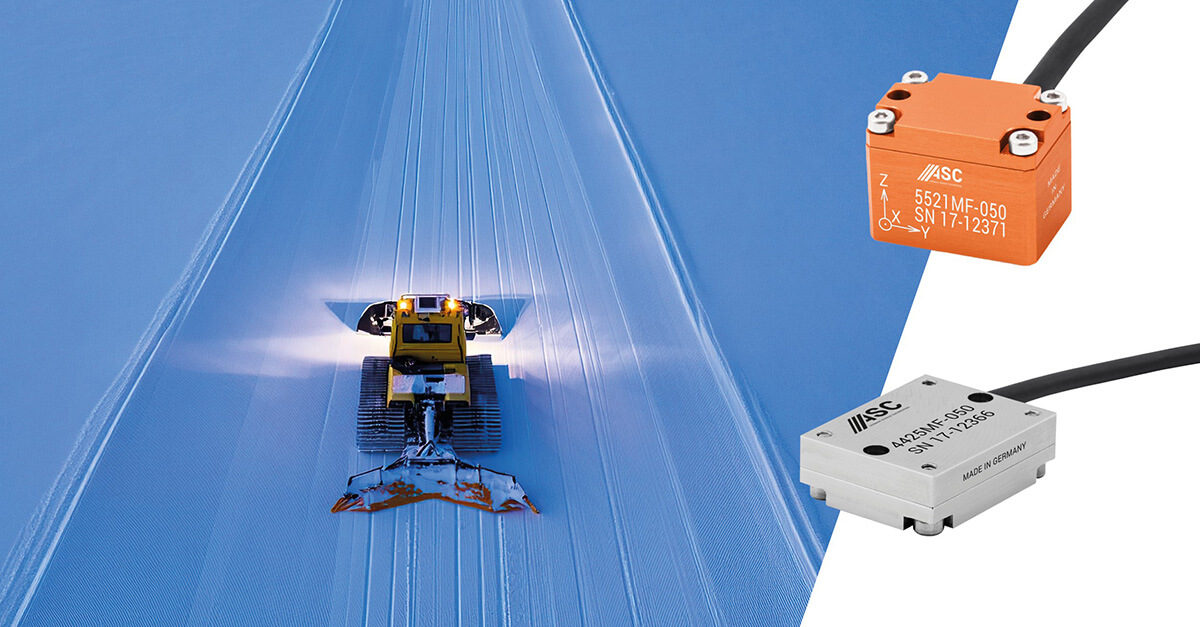
ASC MF series for the perfect finish to any slope
As this winter season draws to a close, snow groomers across the northern hemisphere will have been through their paces on diverse terrains, altitudes, snow and weather conditions. To maximize operational stability and productive output, they need to be rigorously tested prior to going into service.
The testing series typically consists of a three-step process. In each, highly precise, robust sensor technology is leveraged. For the testing of snow groomers from a leading global manufacturer, ASC delivered dedicated Medium Frequency (MF) accelerometers of the ASC 4421MF (uniaxial) and ASC 5521MF (triaxial) series to Italy and Canada.
Based on proven MEMS technology and the capacitive operating principle, the ASC MF series achieves superior test outcomes. Its wide measuring range (2g to 200g), broad frequency response range (DC to 7 kHz) and outstanding temperature and long-term stability achieve high accuracy and measurement repeatability over long test periods and varying conditions.
The sophisticated spring-mass-damping system of ASC MF accelerometers offers further significant advantages, including the detection of smallest constant and linear accelerations (<10 µg) and interference-free data acquisition at all times: no signal-loss nor settling time (following major impacts, overload events or during start-up).
Intense lab and real-word testing
First, vehicles are evaluated in their true environment of intended use. For these “road tests”, they get equipped with comprehensive mobile measurement technology to record realistic load profiles. Sensors capture the forces, torques and vibrations while driving over the piste, from which the accumulated load profile impacting the snow groomer in a unique mountain setting is calculated. This road load data acquisition (RLDA) serves as the basis for subsequent simulation on test benches.
In the second testing phase, the field data is used on stationary test rigs in the lab to analyze and improve the vehicle and its components. Under controlled conditions, these simulate the extreme drive loads and resistances encountered in alpine regions. For example, to strengthen the durability of transmissions and axles, among other parts. Since snow groomers operate on gradients of up to 100% (45°), the functions of engine lubrication and fueling systems are scrutinized on extreme inclines. Other components such as hydraulic hoses or the driver’s cab are subjected to fatigue tests to ensure they can resist vibrations over the long term.
Taking shifts to ensure customer satisfaction
Lastly, extensive field tests running through entire skiing seasons complete the validation process before a new vehicle goes into serial production. In addition to vehicle safety, durability and performance, drive comfort is another key focus: to ensure healthy operators and less downtime. For example, driver seats are evaluated in real-world use to validate shock and vibration damping and minimize stress on the driver. To simulate long-term use, vehicle prototypes are often employed in shift operation throughout an entire season, to analyze wear patterns under continuous loads.
The result: reliable vehicles for freshly groomed slopes throughout the winter season – for consistent grooming quality and satisfied winter resort customers.
Read more:
ASC 4421MF uniaxial accelerometer
ASC 5521MF triaxial accelerometer