Global increase in bridge collapses
Whether from material fatigue, over-use, structural damage through the impact of climate change or natural disaster – or combinations of the above: in the 21st century alone, over 80 major road and rail bridges globally collapsed to date. Not least the Carola bridge in Dresden, Germany (September 2024), a vital traffic artery crossing the Elbe river. Or the massive 758 m Hongqi highway bridge in China’s Sichuan Province (November 2025), following a landslide that destabilized the brand-new construction.
On March 18-19, 2026, the 35th Dresden Bridge Building Symposium (DBBS) hosted by the Institute of Concrete Structures at TU Dresden, Germany, will focus on ensuring effective and safe bridge construction and maintenance around the globe. The annual trade event, convening experts from all over the world, offers lectures, professional networking and exhibits of the latest technologies supporting safe and sustainable bridge construction.
Join live demo of dedicated bridge safety sensors
This year, German sensor specialist ASC will demonstrate the efficiency of its high-performance, robust yet flexibly installed accelerometers. “To showcase the value for bridge operators through efficient monitoring, we’ve built a realistic model railway track and bridge,” explains Markus Nowack, Application Engineer at ASC Sensors. Various ASC sensor types will monitor, calculate and integrate the live data into an overall sensor system. ”Our demo shows how appropriate sensor solutions can help prevent costly issues, at minimum upfront investment and ongoing effort.”
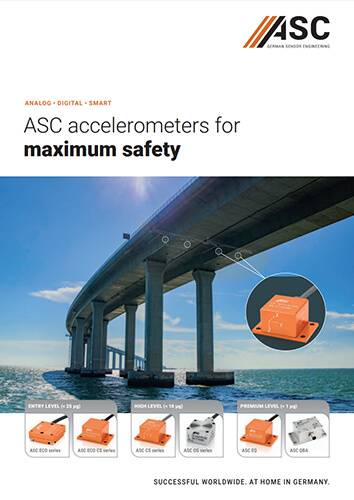
Their dedicated bridge monitoring ASC Sensor live demo will take place at booth #20 throughout the DBBS. Based on the expertise ASC has been developing through novel research partnerships and pioneering real-word applications, several series of inertial sensors have emerged that can be flexibly adapted to the individual needs bridge operators.
ASC inertial sensor technology applied globally
For example, ASC inertial sensors are utilized in monitoring the longest road bridge-tunnel system in the world: the Hong Kong–Zhuhai–Macau Bridge in the South China Sea. In cooperation with DB InfraGO AG, ASC is piloting the monitoring and proactive maintenance of critical railroad bridges in Germany.
High-precision ASC QBA quartz accelerometers have been integrated in a large viaduct that forms part of the UK’s HS2 program, to ensure smooth, safe, stable operation under the extreme stress loads of high-speed railway. In collaboration with The German Federal Institute for Materials Research and Testing (BAM), Berlin, ASC is breaking new ground with its ASC AiSys® ECO series by helping to develop new methods for digital structural monitoring and proactive maintenance management of intensely frequented road bridges.
Come see us at DBBS, booth #20
“We look forward to discussing your opportunities in Dresden,” says Nowack. “See us at our booth or contact us online to discuss ways to increase the safety and efficiency of your bridge by applying the latest, efficient sensor technology innovation.”
Learn more: ASC accelerometers for maximum bridge safety