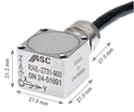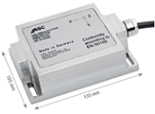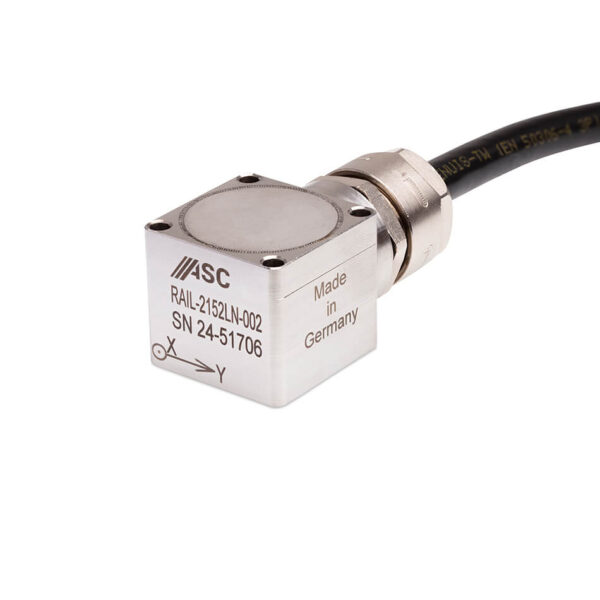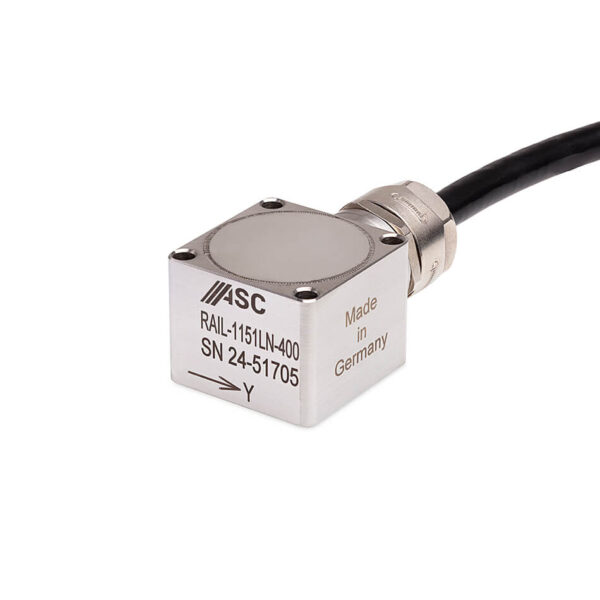
ASC RAIL-1151LN
Uniaxial, capacitive
Standards: EN 50155
Measurement range: ±2 to ±400 g
Noise density: 7 to 400 µg/√Hz
Frequency range (±5 %): DC to 1000 Hz
With the ASC RAIL series of MEMS-based precision accelerometers and gyroscopes certified to EN 50155 and other relevant industry norms, ASC Sensors empowers railway networks across the world. These robust analog, digital and smart sensors set new milestones in railway safety, capacity and productivity.
![]() |
|
|
![]() |
|
|
![]() |
|
|
| EN 50155 |
|
|
| EN 50121-3 |
|
|
| EN 45545 |
|
|
Inertial sensors play a critical role in accurately measuring vibrations – impacting vehicles as well as rail infrastructure. ASC accelerometers and gyroscopes are integrated in tailored measurement systems to enable continuous infrastructure monitoring from regular in-service trains without service disruption. Based on accurate results, deviations in longitudinal height, dynamic direction or distortion of tracks are calculated. Applications include:
Rolling stock, too, is constantly being monitored to ensure safe, efficient operation and cost-effectiveness. For example, various ASC sensors installed at the axle box, bogie frame and diverse points across the vehicle body accurately determine accelerations. This helps keep track of running dynamics which, in turn, prevents derailment e.g. as high-speed trains negotiate sharp curves. Applications include:
Meeting diverse relevant railway norms, the ASC RAIL series’ performance significantly facilitates implementation. Vehicle manufacturers, infrastructure and railway operators, system integrators as well as engineering and testing service providers rely on a proven set of precise, stable sensors ready for installation that drastically reduces individual documentation requirements.
ASC RAIL sensors have been designed to resist the toughest challenges – for optimal performance and long-term use in harsh conditions. With this flexible, dedicated sensor portfolio, rail operators can realize custom solutions for
Please get in touch. We would be glad to support you personally.
E-mail: service[at]asc-sensors.de
Phone: +49 8441 786547-0

Uniaxial, capacitive
Standards: EN 50155
Measurement range: ±2 to ±400 g
Noise density: 7 to 400 µg/√Hz
Frequency range (±5 %): DC to 1000 Hz

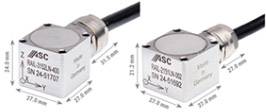
Triaxial, Industrial Grade
Standards: EN 50155
Measurement range: 75 °/s to 900 °/s
Bias stability: 12 °/h
Angular random walk: 0,2 °/√h

Biaxial, capacitive
Standards: EN 50155
Measurement range: ±2 to ±400 g
Noise density: 7 to 400 µg/√Hz
Frequency range (±5 %): DC to 1000 Hz

Biaxial, capacitive
Standards: EN 50155
Measurement range: ±2 to ±400 g
Noise density: 7 to 400 µg/√Hz
Frequency range (±5 %): DC to 1000 Hz

Uniaxial, capacitive
Standards: EN 50155
Measurement range: ±2 to ±400 g
Noise density: 7 to 400 µg/√Hz
Frequency range (±5 %): DC to 1000 Hz

Triaxial, capacitive
Standards: EN 50155
Measurement range: ±2 to ±400 g
Noise density: 7 to 400 µg/√Hz
Frequency range (±5 %): DC to 1000 Hz

Biaxial, Industrial Grade
Standards: EN 50155
Measurement range: 75 °/s to 900 °/s
Bias stability: 12 °/h
Angular random walk: 0,2 °/√h

Uniaxial, Industrial Grade
Standards: EN 50155
Measurement range: 75 °/s to 900 °/s
Bias stability: 12 °/h
Angular random walk: 0,2 °/√h
ASC supplies high-precision inertial sensor solutions for demanding measurement tasks in several industries. Our engineers have a deep understanding of a wide variety of applications – for example in the rail transport sector, the automotive industry or for structural health monitoring systems. Discover now the diverse options that sensors from ASC offer you.

Triaxial, capacitive
Measurement range: ±2 to ±200 g
Noise density: 10 to 680 µg/√Hz
Frequency range (±5 %): DC to 2900 Hz
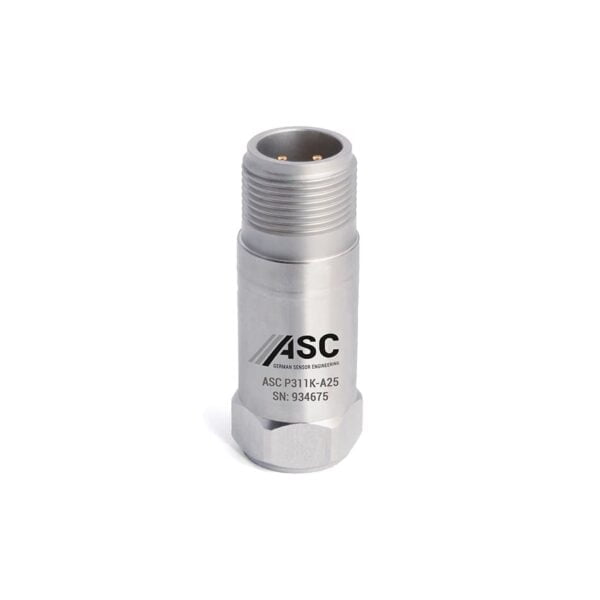
Uniaxial, IEPE
Measurement range: ±16 to ±800 g
Frequency range (±10 %): 1.5 Hz to 16 kHz
Scale factor: 10 mV/g to 500 mV/g
You are currently viewing a placeholder content from Vimeo. To access the actual content, click the button below. Please note that doing so will share data with third-party providers.
More InformationYou are currently viewing a placeholder content from YouTube. To access the actual content, click the button below. Please note that doing so will share data with third-party providers.
More InformationYou need to load content from reCAPTCHA to submit the form. Please note that doing so will share data with third-party providers.
More Information