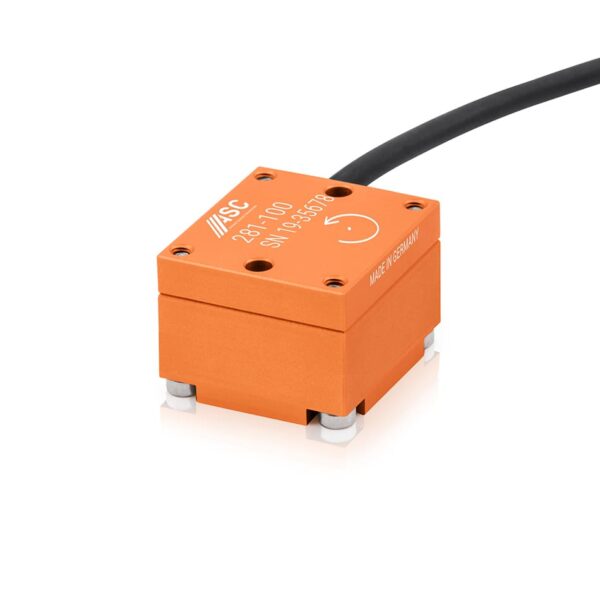
ASC 283
Triaxial, Tactical Grade
Measurement range: 10 °/s to 400 °/s
Bias stability: <0.1 °/h
Angular random walk: <0.01 °/√h
Reliable orientation is fundamental to maritime navigation. Gyro-compassing provides the heading information vessels need, independently of external references. At its heart are gyroscopes capable of detecting even the smallest angular movements with exceptional accuracy and stability.
The ASC 281 (uniaxial) and ASC 283 (triaxial) gyroscopes are ideally suited for these demanding applications. With bias stability of <0.1 °/h, they provide the precision required for accurate orientation and navigation – including where conventional positioning technologies reach their limits.
This becomes particularly important below the waterline. Underwater vehicles, ROVs and other remotely operated systems cannot rely on GNSS signals, even in relatively shallow water. Magnetometers can also be affected by the metal structures of the craft. High-performance inertial measurement technology, therefore, provides a critical source of reliable motion and orientation data.
From surface vessels to subsea exploration, ASC gyroscopes help keep maritime systems precisely on track – even when external navigation signals cannot.
Looking for greater precision in your maritime navigation system? Let’s identify the right inertial sensor solution for you.
Please get in touch. We would be glad to support you personally.
E-mail: service[at]asc-sensors.de
Phone: +49 8441 786547-0
ASC supplies high-precision inertial sensor solutions for demanding measurement tasks in several industries. Our engineers have a deep understanding of a wide variety of applications – for example in the rail transport sector, the automotive industry or for structural health monitoring systems. Discover now the diverse options that sensors from ASC offer you.

Uniaxial, capacitive
Measurement range: ±2 to ±200 g
Noise density: 10 to 680 µg/√Hz
Frequency range (±5 %): DC to 2900 Hz

Uniaxial, capacitive
Measurement range: ±2 to ±200 g
Noise density: 10 to 680 µg/√Hz
Frequency range (±5 %): DC to 2900 Hz
You are currently viewing a placeholder content from Vimeo. To access the actual content, click the button below. Please note that doing so will share data with third-party providers.
More InformationYou are currently viewing a placeholder content from YouTube. To access the actual content, click the button below. Please note that doing so will share data with third-party providers.
More InformationYou need to load content from reCAPTCHA to submit the form. Please note that doing so will share data with third-party providers.
More Information