
ASC 4311LN
Uniaxial, capacitive
Measurement range: ±2 to ±400 g
Noise density: 7 to 400 µg/√Hz
Frequency range (±5 %): DC to 2000 Hz

Railway operators face a persistent challenge: How can thousands of miles of track be monitored frequently and reliably without taking valuable capacity away from regular operations? The answer may already be running on the network.
With smart Continuous Track Monitoring (CTM), regular in-service trains become highly accurate infrastructure monitoring platforms. As they run their usual routes, they continuously collect information about track geometry and condition – creating the data foundation for predictive maintenance without requiring separate measurement runs.
Now, DB Systemtechnik (DBST) and ASC Sensors have taken this concept an important step further. Based on high-precision inertial sensor solutions from ASC, their newly co-developed wireless smart sensor platform is designed to make CTM substantially easier to install, certify and scale – opening the technology to more trains, routes and infrastructure operators.
CTM is a proven concept. Since 2018, ASC sensor technology has been in use at DBST including on active high-speed trains at 300 km/h and beyond. With over three million kilometers covered by some CTM trains, ASC’s sensors are still running smoothly. It’s that precision technology, its strong reliability and the cutting-edge expertise accumulated by both project partners that global rail customers can benefit from going forward.
Robust capacitive accelerometers and gyroscopes installed close to the wheel-track interface are able to constantly capture critical track geometry parameters while trains are in service. Longitudinal level, for example – responsible for 70 to 80 per cent of all track defects – can be determined every two centimeters, independent of train speed. According to EN 13848, cumulative measurement uncertainty across the measurement chain must remain below 0.5 millimeters. Achieving this level of precision requires a sampling rate of at least 1 kHz – 1,000 measurements every second.
However, the new approach goes beyond simply generating measurement data.
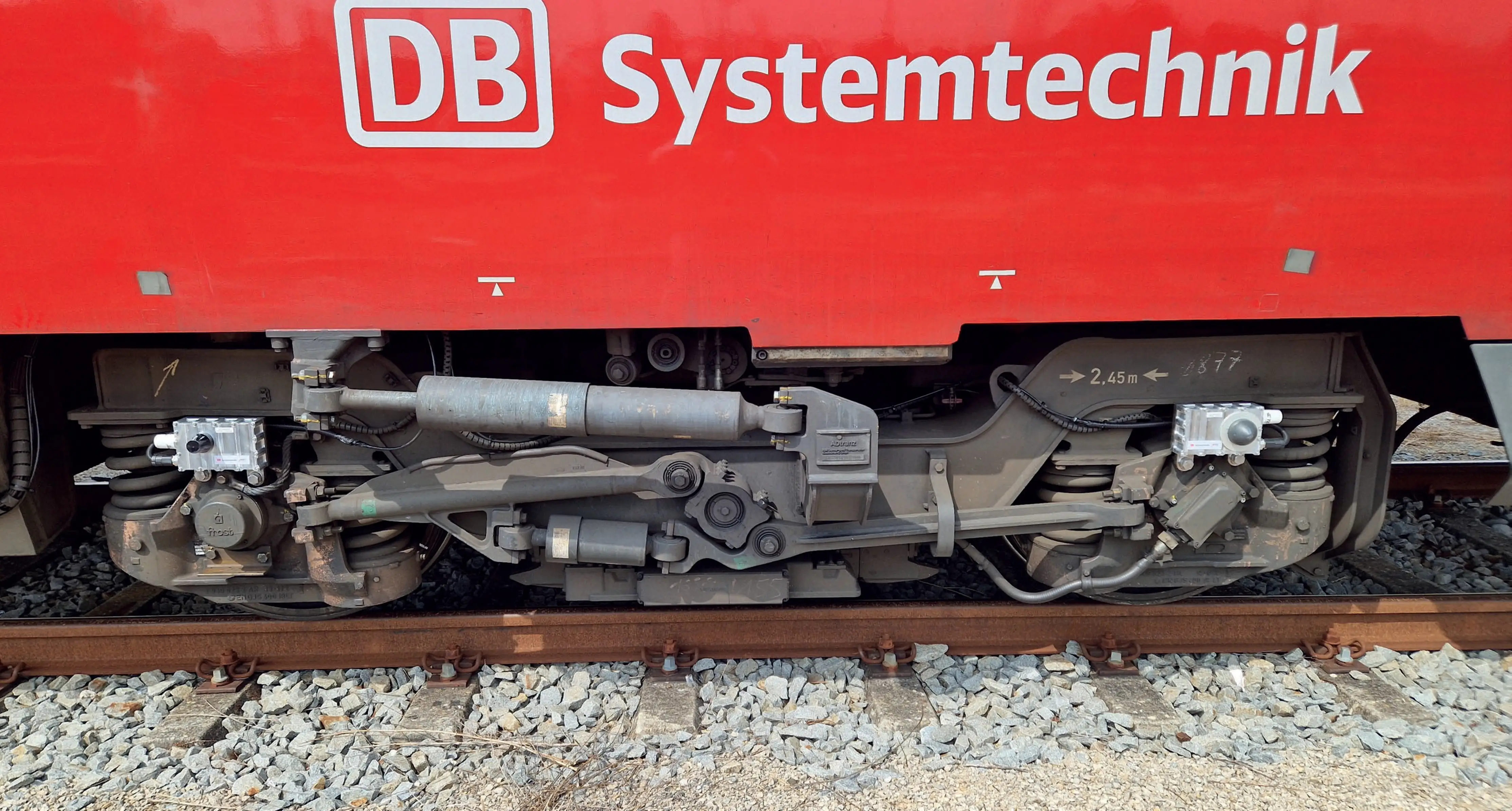
ASC Sensors and DBST have created an integrated smart sensor platform: Compact Satellite Boxes positioned on the vehicle communicate wirelessly, while a computing unit processes and synchronizes the measurement information. GPS provides positioning information, Bluetooth connects the distributed measurement nodes and an LTE module enables data transfer to a computing center via the cloud. These elements form an autonomous measurement architecture distributed across the train – without the restraints, complications and significant costs a wired system would induce.
The DBST/ASC smart sensor platform essentially consists of two main components: Satellite Boxes containing capacitive ASC accelerometers – installed on wheel set covers – and a Computing Box, which incorporates high-precision ASC accelerometers and gyroscopes to measure angular velocity. Both sensor types are used to determine longitudinal level and other parameters of track geometry. The Satellite and Computing Boxes feature an analog front end as well as an ASC µ-controller to process the local measurement data.
High-performance battery modules provide reliable power supply. Each sensor box is equipped with GPS modules and GPS antennas enabling exact localization as well as the continuous synchronization of sensor data to ensure consistency, accuracy and completeness of the gathered data. Seamless communication across the sensor platform runs via Bluetooth Low Energy wireless technology. The Satellite Boxes operate as “slaves” and transmit measurement data to the Computing Box hosted by DBST, i.e. the “master”, where track geometry parameters are calculated. These include longitudinal levels derived from accelerations and speed, twist and dynamic vehicle deviation.
The platform also features a built-in low-energy LTE module to transmit data to the cloud. No additional antennas are required on the vehicle roof for operation, nor is there a need for a central unit inside the vehicle body or for any wiring. The new system, therefore, is completely wireless, smart and scalable.
A decisive turning point for innovative CTM to go into the series is wireless communication. Conventional wired CTM installations require considerable engineering and vehicle integration. Substantial costs are associated with vehicle-specific engineering and approvals. The goal of the new architecture is, therefore, to reduce complexity and expenses across hardware, engineering and certification.
For operators, key benefits include:
Without wireless technology, scaling CTM across large fleets would require extensive cabling, technical modifications and corresponding certification effort. The smart platform is designed specifically to remove these barriers – while retaining the proven inertial sensor performance and reliability on which CTM depends.
Smart CTM transforms vehicles that already run the network every day into a powerful source of infrastructure intelligence. It helps operators detect change earlier, plan maintenance timely and more precisely and increase network availability – while significantly reducing the costs of repair, issue inspection and management as well as reputational damage.
Want to see how smart CTM could transform infrastructure monitoring on your network? Talk to our team and discover how DB Systemtechnik and ASC Sensors can bring predictive railway maintenance onto your track.
Uniaxial, capacitive
Measurement range: ±2 to ±400 g
Noise density: 7 to 400 µg/√Hz
Frequency range (±5 %): DC to 2000 Hz

Uniaxial, capacitive
Measurement range: ±2 to ±400 g
Noise density: 7 to 400 µg/√Hz
Frequency range (±5 %): DC to 2000 Hz
You are currently viewing a placeholder content from Vimeo. To access the actual content, click the button below. Please note that doing so will share data with third-party providers.
More InformationYou are currently viewing a placeholder content from YouTube. To access the actual content, click the button below. Please note that doing so will share data with third-party providers.
More InformationYou need to load content from reCAPTCHA to submit the form. Please note that doing so will share data with third-party providers.
More Information