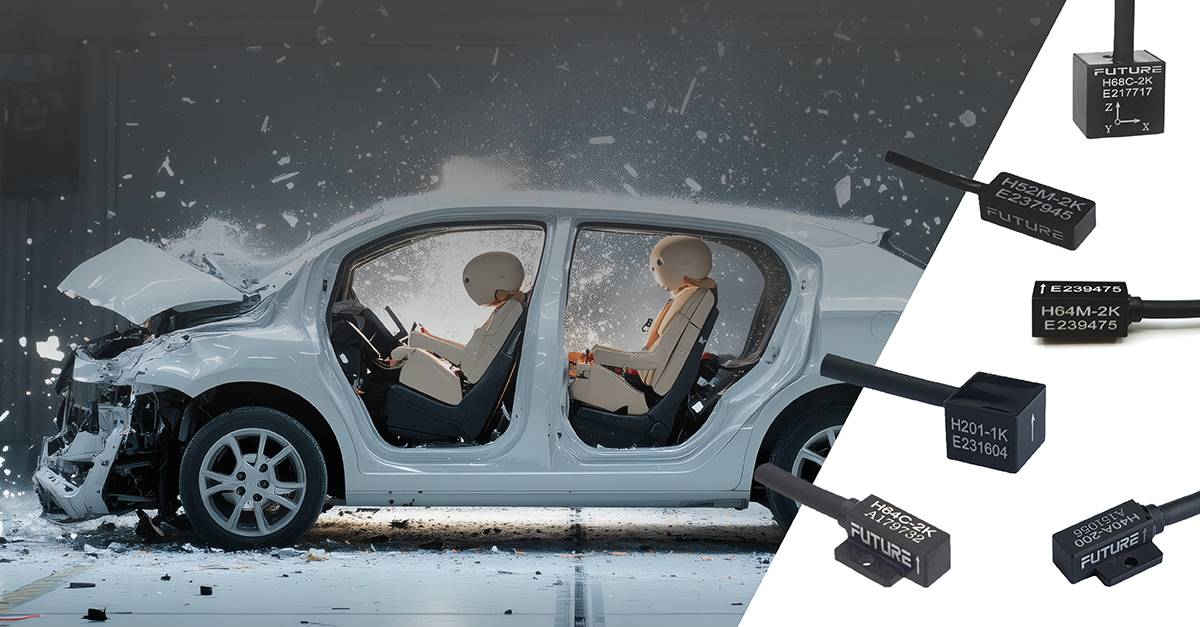
Through its exclusive partnership with Shanghai Future Technology Co., Ltd. (Future Tech) for the European Union except Italy and Spain, ASC now offers a comprehensive range of high-performance piezoresistive accelerometers for crash testing. This adds significant customer value to ASC’s established inertial sensor portfolio.
When a sensor becomes central to the test schedule
Crash testing creates highly specific measurement challenges. Sensors must reliably capture extremely fast events and severe acceleration loads. Depending on the test, requirements can vary materially in measurement range, frequency response, dimensions, weight or mounting configuration.
In anthropomorphic test devices (ATDs, or crash test dummies), for example, every gram and millimeter matter. Future Tech’s compact MEMS sensors weigh between just 0.3 and 10 grams. For full-vehicle crash testing, meanwhile, uniaxial sensors cover measurement ranges from 100 to 6,000 g and capture impact pulses across frequencies from 0 Hz (DC) to 7,000 Hz.
The portfolio includes uni- and triaxial accelerometers for occupant protection testing that meet key requirements of SAE J211 and SAE J2570, as well as dedicated solutions for pedestrian impact testing. Customers can also select different cable lengths and connectors or integrate Dallas DS2401 chips, allowing sensors to be adapted to specific test setups.
Availability can be just as critical as performance
There is also a highly practical consideration: timing. Test vehicles, facilities and engineering teams represent significant investments. If the required sensor is unavailable, the delay can jeopardize the entire test schedule – while substituting a less suitable measurement solution can compromise results.
This is where Future Tech sensors add another valuable dimension to ASC’s offering. As their technical capabilities are combined with short delivery timelines and an attractive cost structure – helping customers balance measurement performance, availability and budget.
Fewer interfaces. More application expertise.
However, perhaps the biggest customer benefit of ASC’s expanded portfolio is simplicity. As automotive testing rarely stops at either active or passive safety. Development programs can involve vehicle dynamics, durability, driving comfort, ADAS development as well as crash testing – each creating distinct measurement challenges.
ASC’s established portfolio of capacitive accelerometers, gyroscopes and inertial measurement units already support demanding automotive development, testing and monitoring tasks; adding high-g piezoresistive technology means customers can now turn to ASC for an even broader range of key measurement requirements.
For automotive developers, this means fewer supplier interfaces and less time spent sourcing solutions through a single, competent partner for selecting the right technology for the task at hand. It further means access to experts who understand not simply the sensor, but the measurement challenge behind it.
Because ultimately, the best sensor solution isn’t about adding yet another component to a test setup. It’s about getting accurate data, on time, conveniently integrated in the test setup – making automotive development safer, faster, easier and more economical.
More about Future Tech piezoresistive sensor technology available through ASC Sensors: https://www.asc-sensors.de/en/news-en/asc-sensors-brings-high-performance-crash-test-sensors-to-europe